picture hanging measurements

free gallery wall calculator

Easily position fasteners so you can focus on the installation layout

  • suitable for home or gallery
  • use one or two hook methods
  • full version is at hangcalc.com a progressive web app you can add to your home screen

input what you need to, choose the results you want

There are many ways to install pictures depending on fastening methods available, personal preferences, tools and equipment. Hangcalc can help in various scenarios and for different personal methods or processes. Everything can be done with a pencil, tape measure and spirit level (ideally one with a measurement scale on it).

Install your artwork accurately using these calculators.

  • the main calculator on this page helps for a wall section with multiple work positions.

Other on page calulators are:

  • horiz, which calculates horizontal spacing options
  • solo to install individual works one at a time in any position; and
  • vert, which helps with vertical groups in a work position.

choose your measuring units

details

The default unit is millimeters, which are convenient to measure and has zero decial places. Inches or meters use decimal numbers to three decimal places. A table of equivalents in sixteenths is provided for reference, and the math calculator does conversions to and from decimal inches. This setting applies to all calculators on a page.

1/16 = 0.063

1/8 = 0.125

3/16 = 0.188

1/4 = 0.25

5/16 = 0.313

3/8 = 0.375

7/16 = 0.438

1/2 = 0.5

9/16 = 0.563

5/8 = 0.625

11/16 = 0.688

3/4 = 0.75

13/16 = 0.813

7/8 = 0.875

15/16 = 0.938

basic approaches to installing artworks

Often works are placed by personal preference, with a "yes, it feels right just there". There are two simple ways to determine fastener positions shown below.

  • First measure the works to be hung and note down required frame data using paper, pdf template or built-in data table.

  • Required measurements are:
    a) outer horizontal width,
    b) outer vertical height; and
    c) any adjustments for fastener locations: ie, the vertical drop from the top frame edge to fastener(s) - either to taught hanging wire or d-ring tops; and, if two fasteners are used, a horizontal inside adjustment for d-rings or fastener locations.

  • Hold an artwork in the location you desire and follow method 1) or 2).

  • You can continue to use method 1 or 2 again and again for each work, ie. locating one corner or one centerline at a time.

method 1: mark a corner (top or lower edge) and measure from there

  • Hold a work against the wall where you want it to be and using a soft pencil mark the wall where a corner is (top or lower edge). Set the work safely to one side. Measure how high that corner mark is.

  • Complete "solo" calculator using the corner height as the "reference height" then read out vertical result, ie. select top edge or "lower edge at reference" (depending on which corner). Measure vertically up or down through the corner to "height of fastener(s)" and make a mark.

  • With "to previous edge" being zero (default) read horizontal results and measure horizontally from that fastener height mark to the center. Place fastener or locate hook if using hanging system.

  • If using two fasteners, read results for 1st and 2nd fasteners and measure horizontally from fastener height mark. Place fasteners or locate hooks if using hanging system.

method 2: mark a vertical centerline and measure from there

  • Decide where you want the work's centerline to be, eg. half way between two points or to one side - maybe using golden ratio ("length/phi") a phi button is in pop-up calculator - and using a soft pencil mark the wall where the centerline will be.

  • Hold the work against the wall roughly on the centerline and mark the height of the top or lower edge. Set the work safely to one side. Measure how high that mark is.

  • Complete "solo" calculator fields using the marked height as the "reference height" then read out fastener height result, ie. for "top edge at reference" or lower edge (depending on which edge). Measure vertically up or down through the centerline mark to fastener height and mark that point. Place fastener or locate hook if using hanging system.

  • If using two fasteners, measure horizontally from that point to the "distance from centerline to fasteners". Place fasteners or locate hooks if using hanging system.

planning key measurements

If you have more works or want a group arrangement, it is often better to plan your layout in advance. That way you can experiment with different arrangements first. You will need to note down not just just frame dimensions but also make decisions and plan measurements for positions (corners, centers etc), with planned heights and spacings. But, it is easy using these calculators - have fun!

Heights

You can pre-plan the "reference height" ie. top, mid-line or lower edge if you want/need a particular height. This might be to avoid objects or meet specifications for a work or group. As a guide a work's center point (mid-line alignment height) is generally suggested to be around the "average" eye-line, that is: 57-60 inches or 1450-1500 mm high. This mid-line is sometimes suggested as 50% of the wall height. Higher or lower is just fine depending on circumstances and preference.

Spacings

Pre-plan horizontal spacing like "to previous edge" measurement. For example, decide a "first/end space" and/or "inter-work" horizontal spacings beforehand if you want/need specific spacing. This might be for aesthetic reasons or to meet specifications for a group. Horizontal and/or vertical spacing between works in a group are suggested as 3 inches or 80 mm, but wider to expansive layouts - it is up to you.

Groups

For groups it is often useful to lay them out in front of the wall on the floor; and then arrange and rearrange until the group feels right. For example, so that no one piece dominates and there is an appealing distribution of content, colors and tones etc. and good distances between works. After that, do a sketch on paper with key parameters, like target heights, centerlines, inter-work and end spaces. These key points and can be marked on the wall using pencil marks or small amount of long release time painter's tape. Remove pencil marks with a soft plastic eraser.

specific purpose calculators

Specific purpose calculators for horizontal spacing (horiz), installing an individual work (solo); and for a vertical group of works (vert)

  • using horiz
    • enter data into the "inputs" section, ie. the section width, each work's width and how many works. The results provide options for adjusting your spacings in various ways
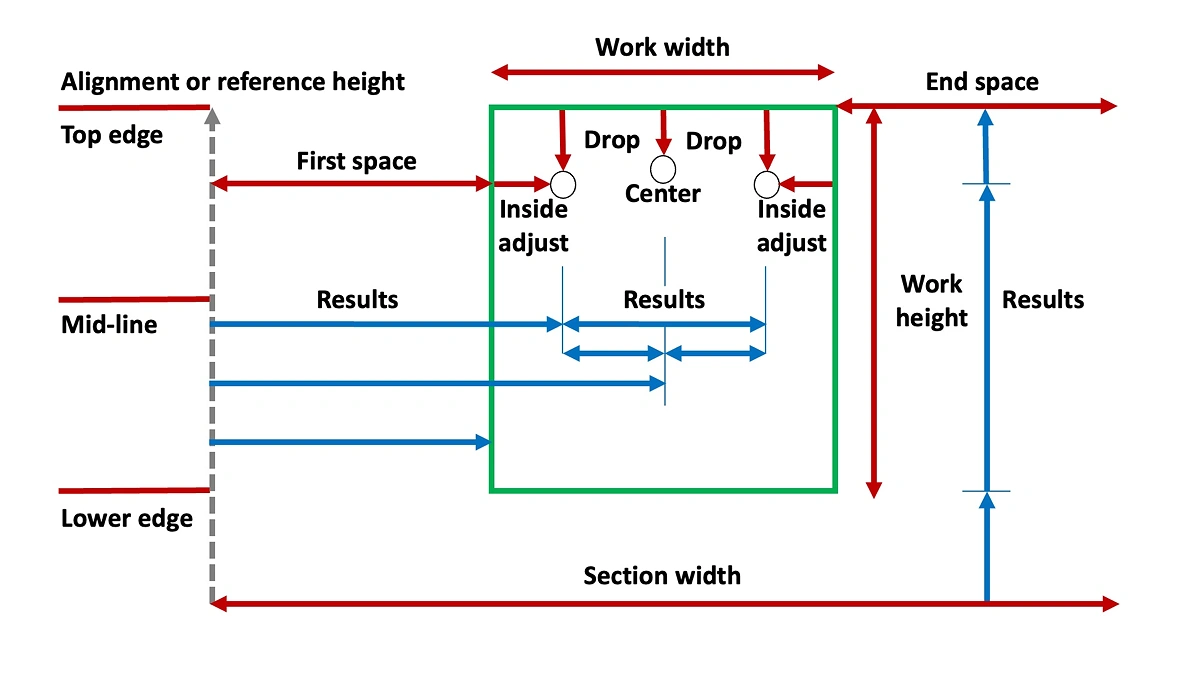
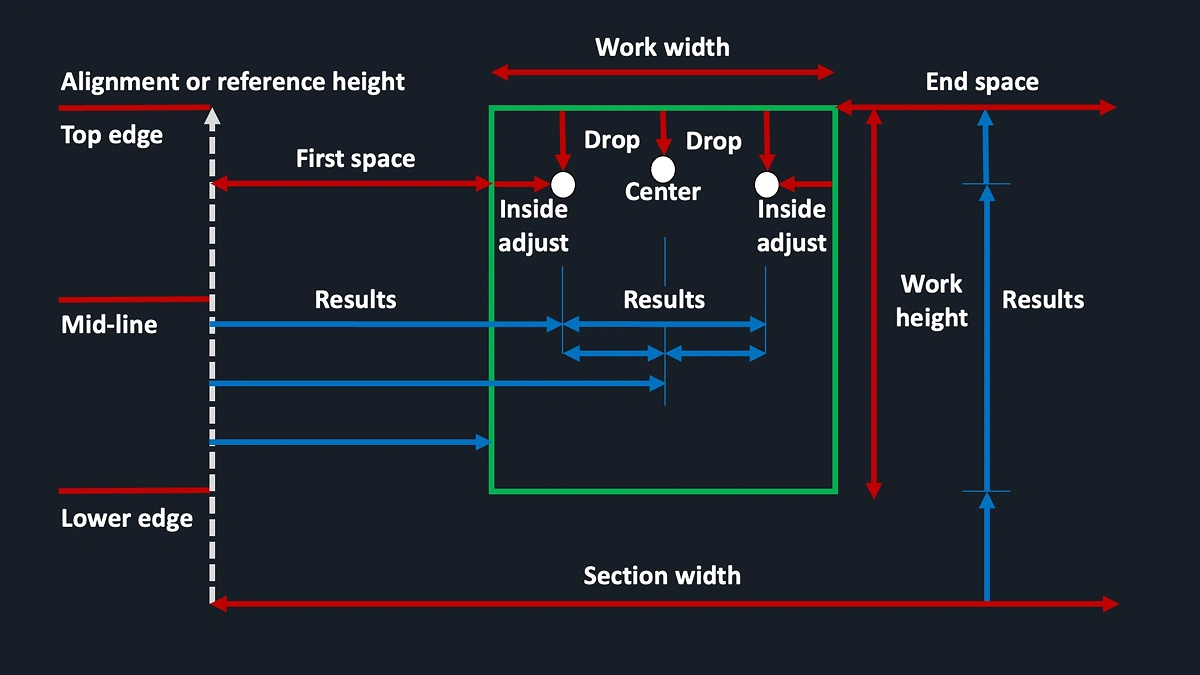
    picture hanging calculator diagram
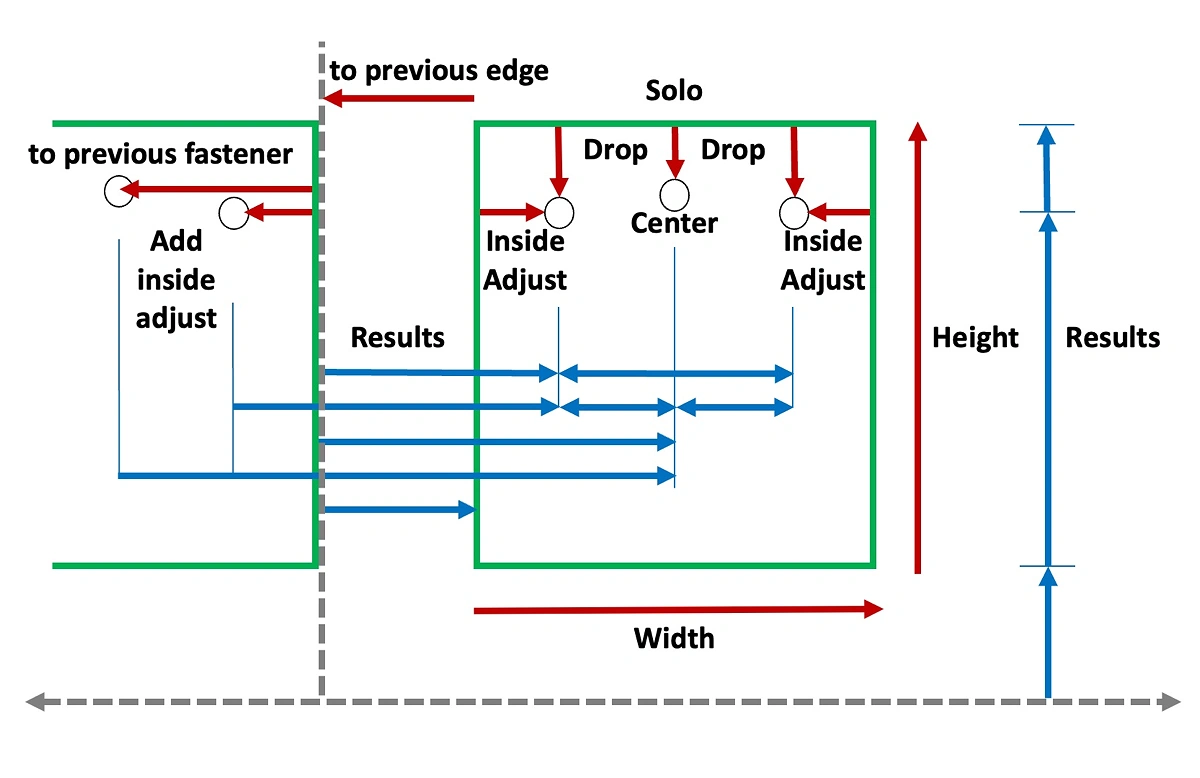
  • using solo
    • a pop-up lightbox form asks for all the inputs you need and provides all the results required to install a single work

    • enter work details data into the inputs section, ie. outer width, outer height, drop to fastener, and inside adjustment if using more that one fastener

    vertical

    • decide on the work's vertical position. This can be done by placing the work on the wall and marking a key position (with pencil or painter'stape), ie. top edge, lower edge centerline etc.

    • alternatively, a decision can be made that the work should be at a particular height. For example, mid-line at 1450mm, or top edge or lower edge at a specified height. Input this vertical reference height

    • results are shown for three vertical height options ie. chosen reference height at top edge, mid-line or lower edge

    horizontal

    • then optionally decide a relative horizontal position. If no horizontal position input is used the horizontal result measurements will show the results for the work's own outer width

    • option a) 'to previous edge' is to measure fastener positions from a previous work or wall edge

    • option b) 'to previous fastener' an additional previous work inside adjustment can be added. This is useful if you want to place fasteners before installing the works. Using option b) place a level (with a measure scale) with one end rested at zero under the previous work's fastener, then the horizontal distance to the first or center fastener can be marked quickly

    • a solo work's centerline can also be used to place one or two fasteners. For two fasteners the distance from the centerline to fasteners is provided in the results table

    solo work diagram with previous work option
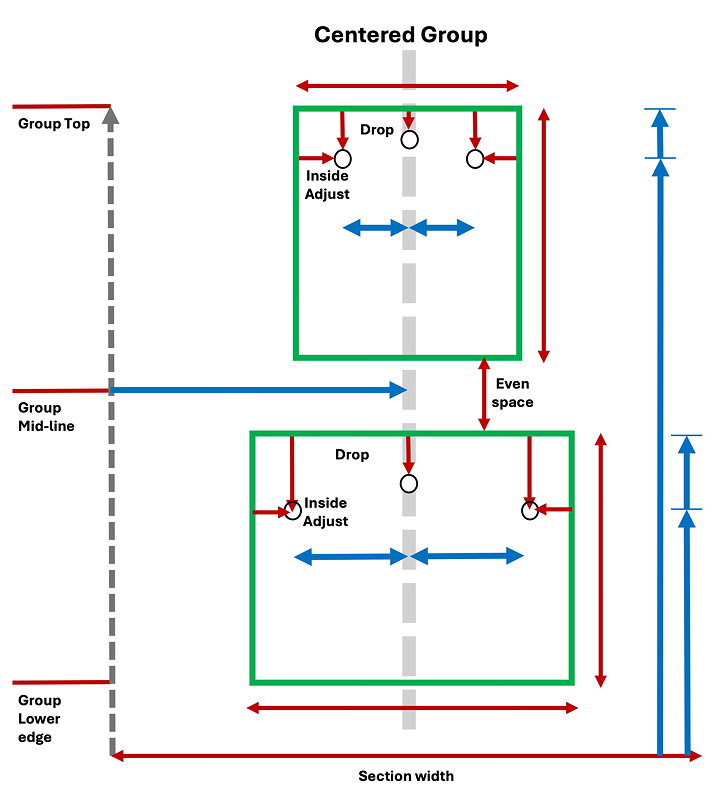
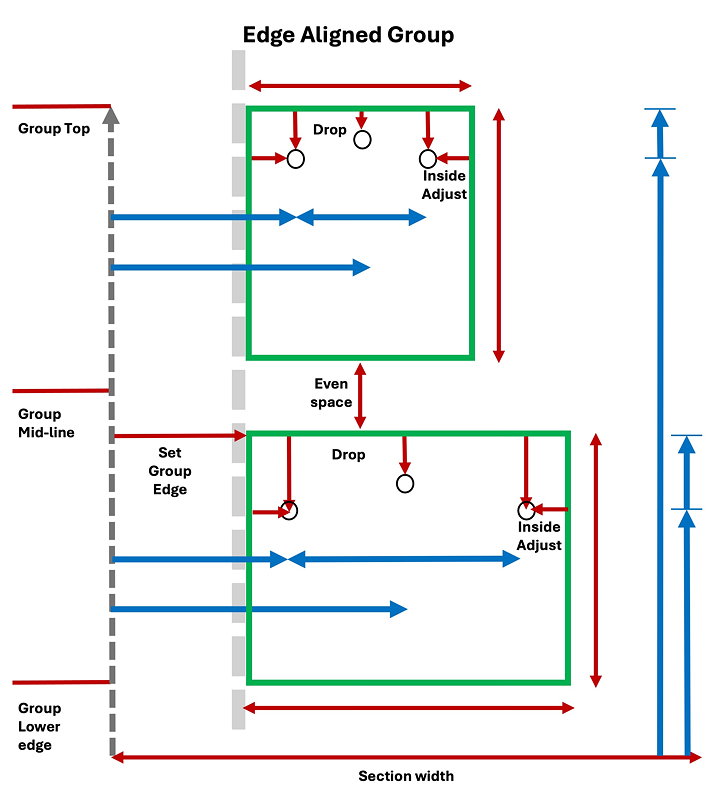
  • using vert
    • enter inputs for as many works as required up to a maximum of six. Inputs and results for both vertical and horizontal measurements are shown in the diagrams below

    centers aligned

    • for center aligned groups a group section width needs to be set to establish a centerline
    inputs and results for center aligned vertical group

    edges aligned

    • the group's vertical edges can be aligned to the left or right
    inputs and results for edge aligned vertical group

main calculator

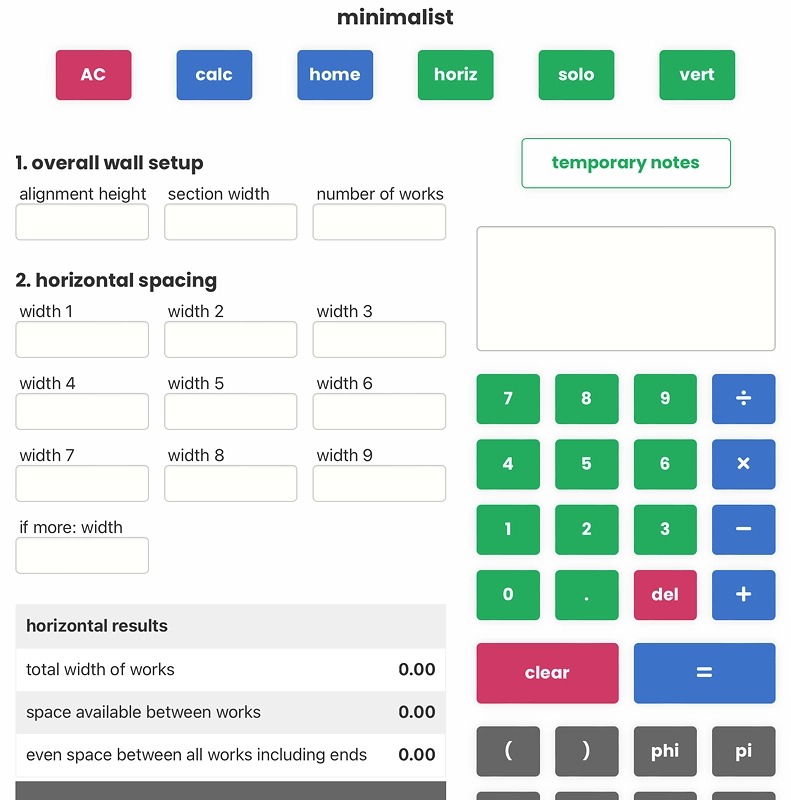
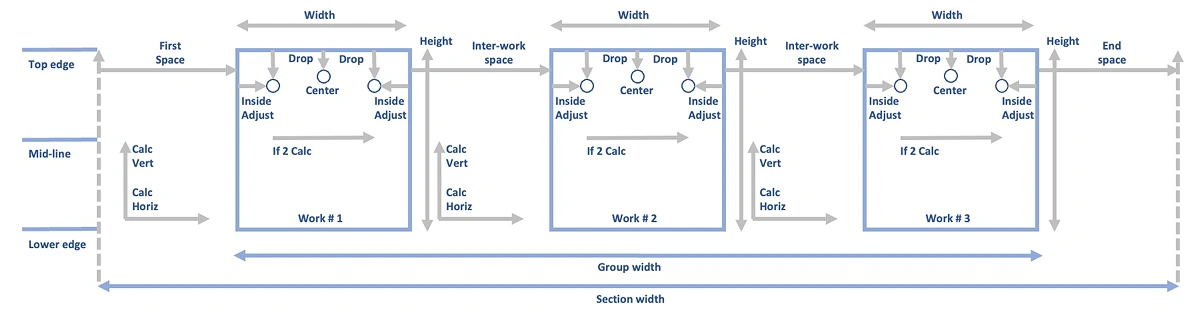
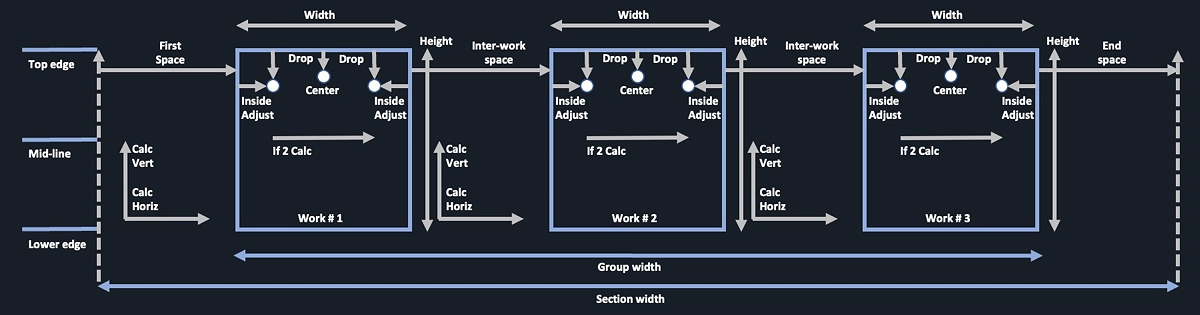
The main calculator combines 'horiz' and 'solo' calculators and has three steps: 1) plan and define overall installation on one or more walls or sections of walls, 2) determine horizontal spacing, then 3) locate fastener positions for individual works and install them.

step 1. plan setup

details

recommended process

  • plan your layout for one or more wall or wall sections and make some notes
  • decide final number and arrangement of works and place works near their final positions
  • collect precise size and measurements of each work. Use built-in data form or PDF templates

step 2: use horizontal spacing calculator to give more precise even inter-work and end spacings. Explore options to choose the right one for your situation. Key points like horizontal sections, group edges or centerlines can be marked on a wall using pencil or painter's tape

step 3 use vertical reference height, previous horizontal measurements and detailed work measurements to determine the location of fasteners for individual works. Vertical alignment options include top edges, mid-lines or lower edges. If a vertical group is in a work position use vert.

Type notes here

This field is required
  • All inputs and results on a page are cleared by AC button.
  • Data on artworks can be kept temporarily using the data button. This data is available in all lightbox calculators. Data can be printed using data form print button.
  • Print current setup of page using "print", and/or save as a pdf if desired.

frame data

# width height drop adjust
1
2
3
4
5
6
7
8
9
10

step 2. horizontal spacing

details
  • enter section width and number of works
  • enter outer widths of all works in the section
  • outer width of a vertical group may be width of widest work in that position

options shown:

  • options are for symmetrical layouts
  • shown first is an even spacing for the wall section including first/end spaces
  • adjustments can be made to the layout including first and end spaces. An even space and total available space for ends are shown. The total available can be used to make asymmetrical layout in the wall section
  • alternatively just focus on the group's spacing and width without including any end spaces
  • distance to centerlines allows whole section or group to be marked out quickly.

Type total width of wall or wall section

This field is required

Select number of works or work positions here (up to 10)

This field is required

Type width of work 1

This field is required

Type width of work 2

This field is required

Type width of work 3

This field is required

Type width of work 4

This field is required

Type width of work 5

This field is required

Type width of work 6

This field is required

Type width of work 7

This field is required

Type width of work 8

This field is required

Type width of work 9

This field is required

Type total width of all other works if >9

This field is required
total width of works
space available between works
even space between all works including ends

adjust including ends

  • set inter-work calc first/end

    Type width of desired inter-work horizontal space

    This field is required
    even first/end space
    available for first/end spaces
  • set first/end calc inter-work

    Type width of desired first / end horizontal space

    This field is required
    even inter-work space

adjust not including ends

  • set inter-work calc group

    Type width of desired inter-work horizontal space for section with zero ends

    This field is required
    width of group
    available for first/end spaces
  • set group calc inter-work

    Type your target overall group width with zero ends

    This field is required
    even inter-work space

distance to centerlines

  • set inter-work calc centers

    Type width of desired inter-work horizontal space for horizontal group

    This field is required

    Type width of first / end space where measurement commences

    This field is required
    work #
    edge to 1st center
    1st to 2nd
    2nd to 3rd
    3rd to 4th
    4th to 5th
    5th to 6th
    6th to 7th
    7th to 8th
    8th to 9th
    9th to 10th
  • centerline to edge/fastener

    Type width of a works inside adjustment, applies to all vary for work#

    This field is required

    vary inside for work #

    work # center to edge center to fastener
    1
    2
    3
    4
    5
    6
    7
    8
    9
    10

step 3. individual works

details
  • enter work details: outer work dimensions
    • drop to fastener is to center of taught frame wire; or if 2 fasteners to top of D-rings; or stretcher depth eg. if on nails or screws. A negative drop can be used for outside fasteners, eg. pins in cloth tabs
    • inside adjust is for a two point hang only and is edges to D-ring centers; or, a set distance depending on installation method
  • enter vertical alignment or reference height
  • optionally add horizontal adjustments:
    • default zero (0) 'to previous edge' gives results table showing horizontals from work's own edge. When measuring from a previous work/edge add that distance
    • in addition to 'to previous edge' adjustment, an extra adjustment can be made if measuring 'to previous fastener'. Add previous work's distance to center; or, if using 2 fasteners, add previous work's inside adjustment. This is also useful for pre-planning.

vertical

Type aligment / reference height for works in decimal numbers e.g. mm or inches to 2 decimal places

This field is required

work details

Type width of work

This field is required

Type the height of work

This field is required

Type work drop to fastener

This field is required

Type inside adjustment for work if 2 fasteners used

This field is required

horizontal

Type horizontal distance to previous work or wall edge

This field is required

Type inside adjustment from work edge to fastener of previous work, eg. to center fastener or to 2nd if two

This field is required

vertical results

horizontal results

  • to previous edge
    previous edge to center
    if two fasteners:
    previous edge to 1st fastener
    distance from 1st to 2nd fastener
    distance from centerline to fasteners
  • to previous fastener
    previous fastener to center
    if two fasteners:
    previous fastener to 1st fastener
    distance from 1st to 2nd fastener
    distance from centerline to fasteners

full pwa version at hangcalc.com

hangcalc screen shot

Useful resources

A4 artwork measurement sheet

pdf for collecting artwork measurements

  • collect all you artwork measurements in one place before you begin
  • helps get you ready to use these calculators

A4 planning notes template

pdf template for your layouts

  • great to use as a background in a notes app

art installation guide

doing an install?

  • some tips on art installation
  • outline of basic calculation methods

on viewing art

everyone has a unique viewpoint

the world's infinite and ubiquitous uniqueness changing from moment to moment requires a determined mental effort to break the bonds of 'ordinary' perception

unique viewpoints

© 2026 alivebeing.com

1. Overall wall setup notes

2. Horizontal spacing

Set section width =

Number of works =

Width 1 =

Width 5 =

Width 9 =

Width 2 =

Width 6 =

Width other =

Width 3 =

Width 7 =

Width 4 =

Width 8 =

Total width of works =

Total space available between works =

Even space between all works (inc ends) =

Options for end / inter-work space:

Set inter-work space = then first/end space =

Set first/end space = then inter-work space =

Set group inter-work = then group width =

3. Current individual work calculations

Alignment height =

Work width =

Work height =

Drop to fastener =

Inside adjust =

To previous edge =

Added previous inside adjust =

Vertical height of fastener(s) by alignment type

Mid-line aligned =

Top edges aligned =

Lower edges aligned =

Horizontal measurements

Previous work/edge to center =

If 2 fasteners, previous work/edge to 1st fastener =

Distance from 1st to 2nd fastener =

And, distance from centerline to fasteners =

To previous fastener

Previous work's fastener to center =

Previous work's fastener to 1st fastener =

Notes:
1. inputs

work details

work width =

work height =

drop to fastener =

inside adjust =

vertical

reference height =

horizontal

option to previous edge =

added previous inside adjust =

2. vertical results
a) mid-line at ref height

fastener height =

top edge height =

lower edge height =

b) top edge at ref height

fastener height =

mid-line height =

lower edge height =

c) lower edge at ref height

fastener height =

top edge height =

mid-line height =

3. horizontal results

to previous edge

previous work/edge to center =

if 2 fasteners, previous work/edge to 1st fastener =

distance from 1st to 2nd fastener =

and, distance from centerline to fasteners =

to previous fastener

previous work's fastener to center =

previous work's fastener to 1st fastener =

Frame measurements

Outer width

Outer height

Drop to fastener(s)

Inside adjustment

1

2

3

4

5

6

7

8

9

10